Modernisation
When should a Lift be modernised? Ten factors to weigh up
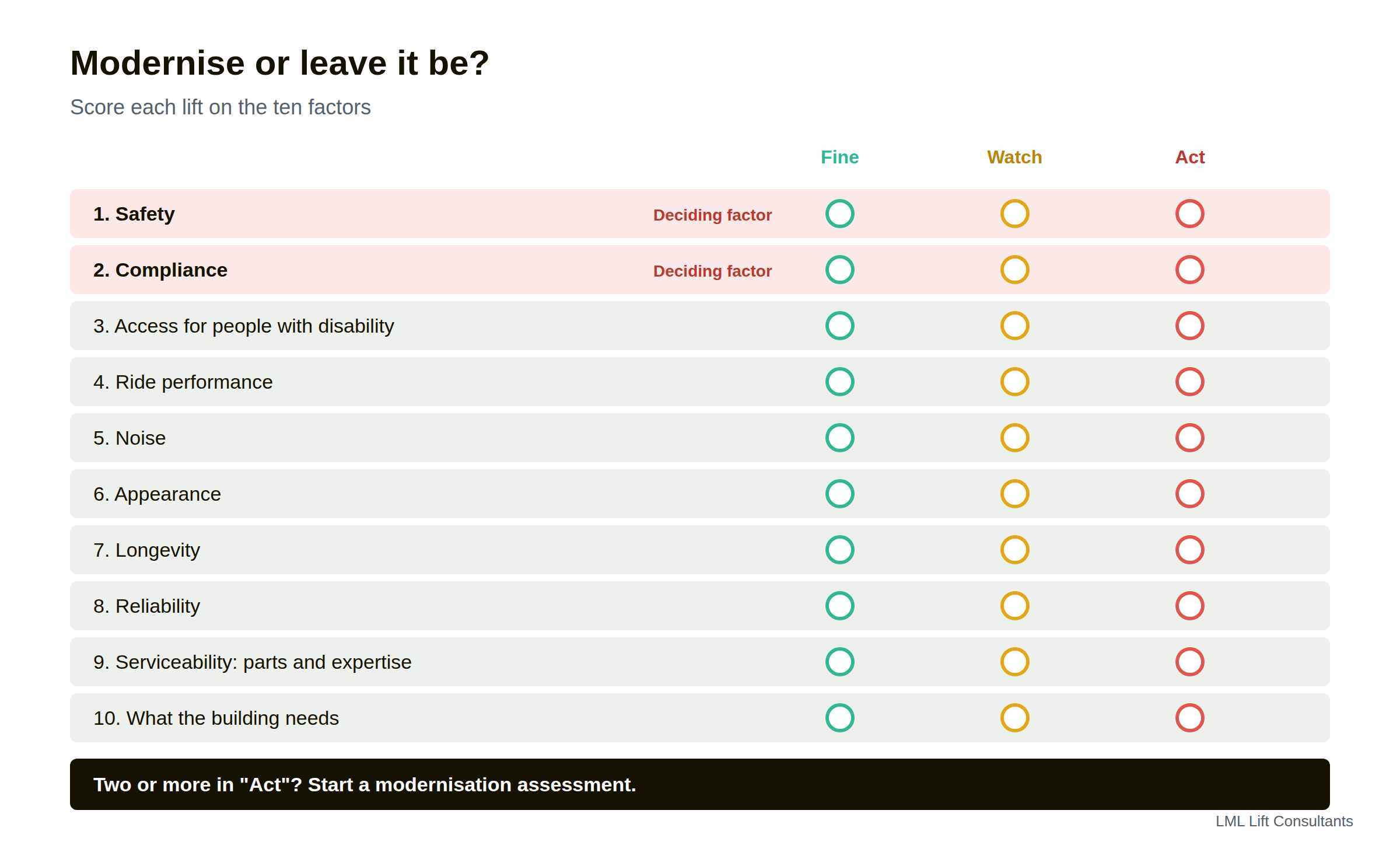
The ten factors that decide whether a Lift should be modernised run from safety and compliance to reliability and the supply of spare parts and technical expertise.
The ten factors that decide whether a Lift should be modernised run from safety and compliance to reliability and the supply of spare parts and technical expertise.
How long does a Lift last before it needs modernising? It depends on the equipment, how heavily the Lift is used and how well it is maintained. Controllers and drives often need replacing well before machines, while other parts of the installation, such as guide rails, counterweights and cabins, may not wear at the same rate.
Want an independent view of your own lifts?
Talk to a consultant"When should we modernise our Lifts?" is one of the questions Facilities and Property Managers ask Lift Consultants most often, and one of the hardest to answer well.
Modernisation is a major capital cost, and the work disrupts everyone who uses the building while it is under way. Modernise too early and you spend money on equipment that still had years of life left. Leave it too late and you face breakdowns, entrapments, compliance problems and a rushed project on the contractor's terms.
There is little practical guidance for the people who have to make the call, especially managers who are new to the job. This article sets out the ten factors we weigh when advising an Owner, and how to use them to decide whether it's time.
Assess every Lift against these ten criteria. The first two outweigh the rest.
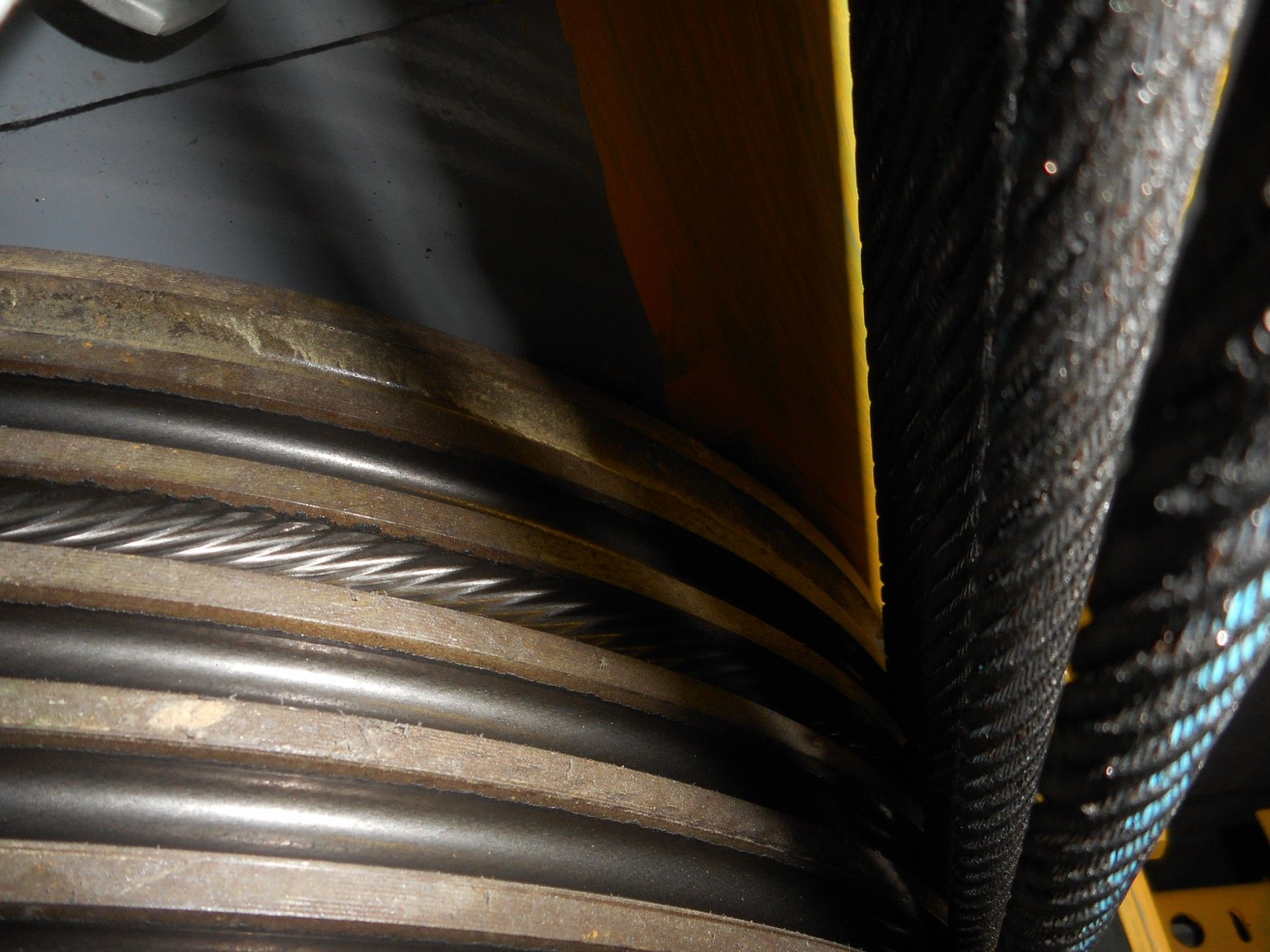
Safety should drive the decision before anything else, starting with the design of the original equipment. Some older designs carry risks that only replacement can remove, such as known weaknesses in gearboxes, machines, brakes and sheaves that could lead to a serious failure, including uncontrolled movement of the Lift car.
Other problems are built into older control systems. Poor levelling, where the car stops above or below the floor, creates a trip hazard, and on many older Lifts it can only be fixed by replacing the controller and drive.
Meeting current standards and workplace health and safety requirements is a serious obligation for any owner. Fixing compliance items one at a time, though, can cost almost as much as modernising and still leaves the building with old equipment.
A full upgrade, while costing more upfront, would have provided significant long-term benefits and cost savings.
Dean Morgan
In one case, an owner accepted a contractor's proposal to remove the compliance and safety hazards from a Lift system that was more than 50 years old. The work cost a six-figure sum. It included guarding for the controller and machine, residual current devices on several circuits, extra pit safety switches, switches on the governor tension sheave and buffers, and a rope brake. The original machine, controller and fixtures stayed.
The owner reduced risk and acted responsibly, but a full modernisation would have removed far more hazards for not much more money. A new controller comes fully guarded, and a new machine has two independent brakes, so no rope brake is needed. Levelling, reliability and serviceability would all have improved as well, and over the life of the building the higher upfront cost would have worked out cheaper.
Modern Lifts must meet the standard for Lift facilities for people with disability (AS 1735.12). The main items include:
Access also affects leasing, because many government and corporate tenants will only lease space in buildings that are fully accessible.
Ride performance is how smoothly the Lift carries people, measured through acceleration, deceleration and vibration. The acceptable standard depends on the Lift's speed. A consultant can measure a Lift's ride quality and compare it with what a modern system achieves.
the most noise there should be inside a Lift car at full speed
Noise inside a Lift car travelling at full speed should be no more than 55 to 60 decibels, and the car should not creak or rattle. It should also keep out noise from the liftwell. Like ride quality, noise can be measured.
Lift interiors should match what tenants and visitors expect of the building, and a tired Lift car in an otherwise refurbished lobby lets the whole building down. Appearance alone rarely justifies a full modernisation, but it often tips the balance, and interiors are usually replaced as part of one.
Longevity is the number of years a Lift can keep serving the building without another major upgrade. A modernisation should deliver at least 15 more years.
callouts a year: the most a modern lift should need
Reliability is measured by breakdowns that need a technician. A modern Lift should need no more than six callouts a year throughout its life.
Poor reliability doesn't always mean a Lift needs replacing, because the cause may be maintenance that isn't good enough. An independent consultant can analyse the breakdowns, find the root causes and establish whether the contractor is meeting its obligations. See How often should lifts be audited?
Serviceability applies to the equipment you have now and to the equipment you might buy.
How many Lifts with our control system do you still maintain? If the answer is 'not many', faults will take longer to diagnose and parts longer to find.
Whatever you buy, make sure at least two maintenance companies can service it for its whole life, or your next maintenance tender will have one bidder.
For existing equipment, ask two questions:
New equipment carries a different risk: some modern control systems are designed so that only the manufacturer can service them properly. Specify new equipment so that at least two maintenance companies can service it for its whole working life. Otherwise you lose the ability to put your maintenance contract out to competition.
Commercial offices, apartments, hospitals, aged care, government buildings and transport hubs all use Lifts differently. Consider who uses the building, when the peaks are, how long people wait, and how long their journey takes.
For busy buildings, consider whether conventional floor buttons or destination control, where passengers choose their floor before entering the Lift, suits the traffic. That decision should rest on a traffic analysis by a consultant.
Lifts in a group are usually modernised one or two at a time, so the building keeps a service throughout. Good planning reduces disruption:
At 222 Exhibition Street in Melbourne, destination control was fitted to the existing lifts before any Lifts were removed from service. The group ran more efficiently during the works, and the project finished ahead of schedule.
LML's lifecycle and feasibility assessment reports on a Lift's remaining life, its performance and the case for upgrading or replacing it. It covers:
It depends on the equipment, how heavily the Lift is used and how well it is maintained. Controllers and drives often need replacing well before machines and rails.
Depends on where the Lift is at in its lifecycle. We can often price both. Piecemeal compliance work on old equipment can cost almost as much as a modernisation and leave the building with a Lift that will still need replacing in the short term.
An independent assessment gives you the evidence for the decision, a scope for tendering and a basis for comparing prices. It also means the recommendation isn't coming from the company that would sell you the new Lift.
The checklist above is a broad guide, and each Lift still needs an inspection. LML Lift Consultants carries out modernisation and feasibility assessments, prepares technical specifications for tender, and manages modernisation projects from start to handover. We have completed more than 230 modernisation projects.
We work on every major brand of Lift and alongside every Lift company in the market, but we sell no equipment and take no commissions.
Ask about a modernisation assessment or call 1300 001 565.
We sell no equipment and take no commissions. Tell us about your building and a consultant will come back to you.