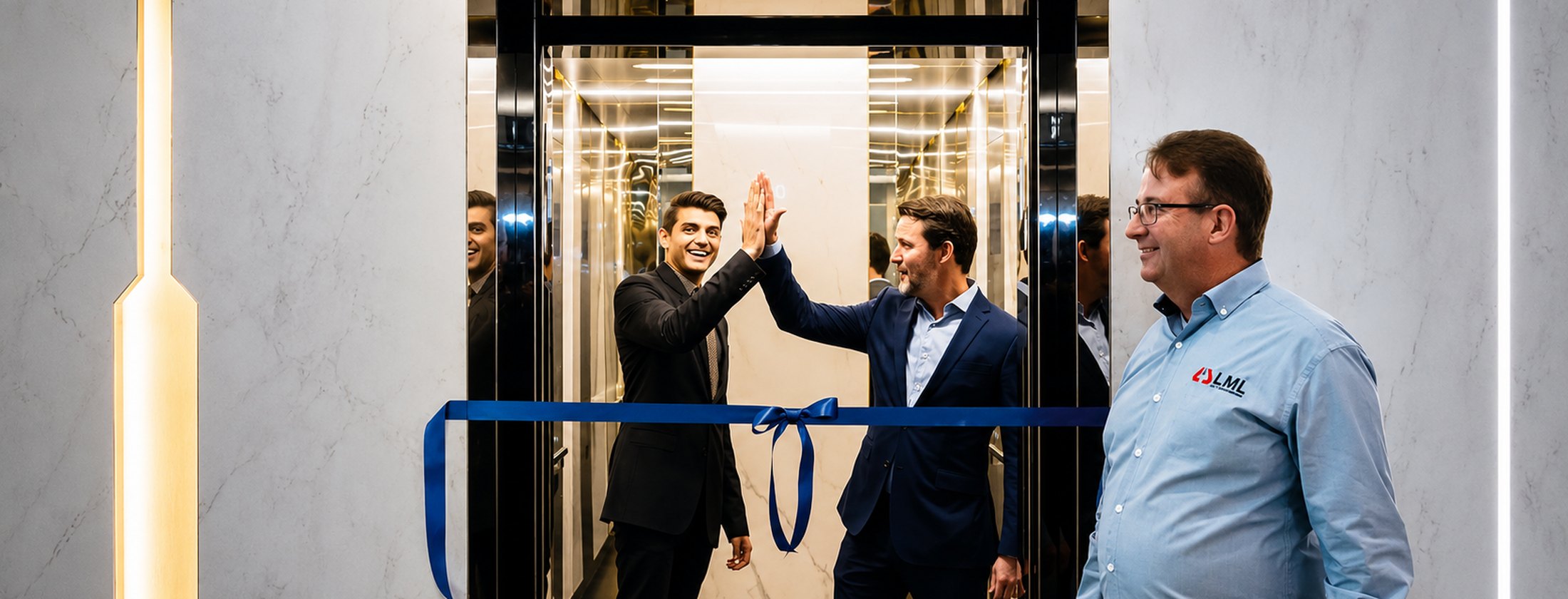
Handover at completion. LML writes the specification, runs the tender and manages delivery, representing the owner through commissioning and the defects liability period.
Services / Upgrade & Replacement
Project management of upgrades and replacements for ageing lift, escalator and moving walk equipment, with LML acting for the owner from specification through to handover.
230+
modernisation projects completed
5 stages
each independently priced, so you can engage one or all
Fortnightly
site inspections against a carried-forward defect register
Five stages: lifecycle and feasibility, technical specification, tender and assessment, contract, and services during construction
Specifications cover heritage, code and accessibility requirements, environmental standards, and defects liability terms with KPIs and financial penalties
During construction: SWMS and drawing review, claim management, witness testing and the certificate of practical completion
Modernisations range from car interior refurbishment through to complete control system replacement. Common elements include new controllers, machines and VF regenerative drives, destination control systems, new car interiors, car operating panels and landing fixtures, door operators, and integration with access control and smart building applications. All of it is delivered to full NCC, Australian, EN and DDA compliance.
230 modernisation projects completed, representing over $7.08M in delivered project value, across commercial towers, mixed-use developments and residential buildings in Victoria, New South Wales, South Australia and Queensland.
See selected projects →End to end consultancy
We provide end-to-end consultancy for modernisation and replacement projects, so vertical transportation systems are upgraded to meet current safety, compliance, accessibility and performance requirements.
From technical specifications and tender management through to construction oversight, testing and completion, we support clients in delivering reliable and efficient vertical transportation systems.
Handover at completion. LML writes the specification, runs the tender and manages delivery, representing the owner through commissioning and the defects liability period.
FAQ
Free advice is not always independent advice, and on lift assets the gap between the two is measured in tens or hundreds of thousands of dollars. Getting the decision right the first time is what protects the budget, and we have many examples where independent guidance has done exactly that.
A contractor's proposal is not usually wrong. It is usually unverifiable. It does not tell you which items are genuinely at end of life and which have serviceable years remaining, whether the proposed scope is the right one for the property, whether the price is competitive, or what the alternatives are. An independent review answers those questions before the money moves, and typically costs a small fraction of the expenditure it examines.
Yes, and it is one of the most common reasons LML is engaged. An independent assessment establishes whether proposed works are technically necessary, whether the scope is appropriate, and whether the price is competitive.
The outcome is not always a reduction in scope. Audits sometimes confirm the contractor's position, and sometimes identify items the proposal missed. What changes is that the owner is making the decision on independent evidence rather than on the recommendation of the party being paid to carry out the work.
Proprietary and closed-protocol are not the same thing, and the difference matters. The major manufacturers supply only their own proprietary equipment, but most of that equipment can still be serviced by other contractors, including Tier 2 firms. The usual constraints are sourcing spare parts, which have to come from the manufacturer, and equipment-specific expertise, rather than an outright technical lock-out. Genuine lock-out does exist, though: where controllers, diagnostic tools or access codes are restricted to a single authorised supplier, it becomes impractical for anyone else to maintain or fault-find on the equipment, and competition at each renewal is materially reduced.
This is one of the most significant long-term commercial consequences of a modernisation decision, and it is generally settled at specification stage rather than at contract stage. Where an owner wants a contestable maintenance market for the next twenty years, the requirement for non-proprietary or open-protocol equipment must be written into the specification before tendering. What we care about is the optimisation of vertical transportation: improving the safety, reliability, performance and longevity of the equipment.
Age alone is not the trigger. The usual indicators are parts obsolescence, rising callback frequency, deteriorating ride quality or door performance, control system failures, and repair costs that no longer make sense against remaining life.
The decision is a lifecycle comparison, not a judgement about how old the equipment is. A twenty-five year old lift with available parts and a good maintenance history may have years of serviceable life. A fifteen year old lift with an obsolete controller and no parts supply may not.
Typical service life before major modernisation is in the range of fifteen to twenty-five years, though controllers and drives commonly reach obsolescence well before the mechanical equipment does. Newer is not automatically longer-lived: the compact machine-room-less units now common in residential buildings are less likely to reach twenty years than the heavier equipment they replaced.
How long any individual lift lasts depends on usage, environment, maintenance quality and whether earlier partial upgrades have been carried out. The more useful question for budgeting is not how long the lift will last but which components will reach obsolescence first, and when. That is what a condition audit establishes.
Obsolescence is the point at which the manufacturer no longer produces or supports a component, and it usually arrives first in the control system rather than the mechanical equipment.
Components are typically manufactured for something in the order of ten to fifteen years from the original release of the equipment, after which supply depends on remaining stock, reconditioned parts or third-party equivalents. The practical risk is time more than cost: an obsolete component that fails can leave a lift out of service for months. Establishing the obsolescence position of your controller and drive is one of the more useful outputs of a condition audit, because it converts an unpredictable risk into a datable one.
Partial modernisation is common, and depending on the condition of the existing equipment and the building it can be the right answer. The structure, guide rails, shaft and sometimes the machine can frequently be retained while the control system, drive, door operator and fixtures are replaced. The constraint runs in both directions: existing site conditions can also mean a full replacement is not feasible, even where it would otherwise be preferred.
What can be retained is determined by condition, compatibility and the compliance position the completed works must meet. A staged approach also lets a committee spread expenditure across budget cycles, provided the staging is planned as a single strategy rather than assembled from successive reactive repairs.
It depends on the extent of the works, and it is one of the more commonly misunderstood areas of lift compliance. Our rule of thumb is to aim for full compliance wherever it is practicable. The code does not force an untouched part of an older lift up to current requirements during a partial upgrade, but it does actively encourage an equivalent level of safety to a new lift wherever that is physically and economically achievable. On any partial upgrade we recommend including the safety and code-compliance items as a minimum.
Where you are altering or replacing specific parts only (door equipment or fixtures, say), it is the newly installed equipment that must meet current standards; the retained components are generally only required to meet the standard that applied when they were originally installed. New lifts are designed and built to AS 1735.1.2, an identical adoption of the European standard EN 81-20:2020, with testing to AS 1735.1.3 (EN 81-50:2020). Significant alterations to an existing installation can trigger requirements that a like-for-like repair would not. The position that applies should be established for the specific installation and the specific proposed works, before the scope is fixed. That is exactly what we do at feasibility stage.
Through five independently priced and independently invoiced stages: feasibility, technical specification, tender, contract draft, and project management through to handover.
Each stage can be engaged separately, so an owner can commission a feasibility assessment without committing to the whole programme. Project management includes a fortnightly site inspection cadence, a recorded defect register carried forward between inspections, witness testing, and confirmation that outstanding defects are closed and handover documentation received before the final stage is signed off.
Both. LML can be engaged for advice alone, or to act for the owner through the full delivery of a project: specification, tender, contract, construction monitoring, witness testing, defect close-out and handover.
Where we project manage, we represent the owner rather than the contractor. That includes a fortnightly site inspection cadence during works, a defect register carried forward between inspections, and confirmation that outstanding defects are closed and handover documentation received before the final stage is signed off.
Bring us in before you go to market. We'll write the specification, run the tender and hold the installer to it.