Dogs on Escalators: what the Standard requires and what owners should do
Why Escalators are dangerous for dogs, the warning sign the Australian Standard requires, and what dog owners and Centre Managers should do.
LML Lift Consultants
4
min read
September 29, 2026
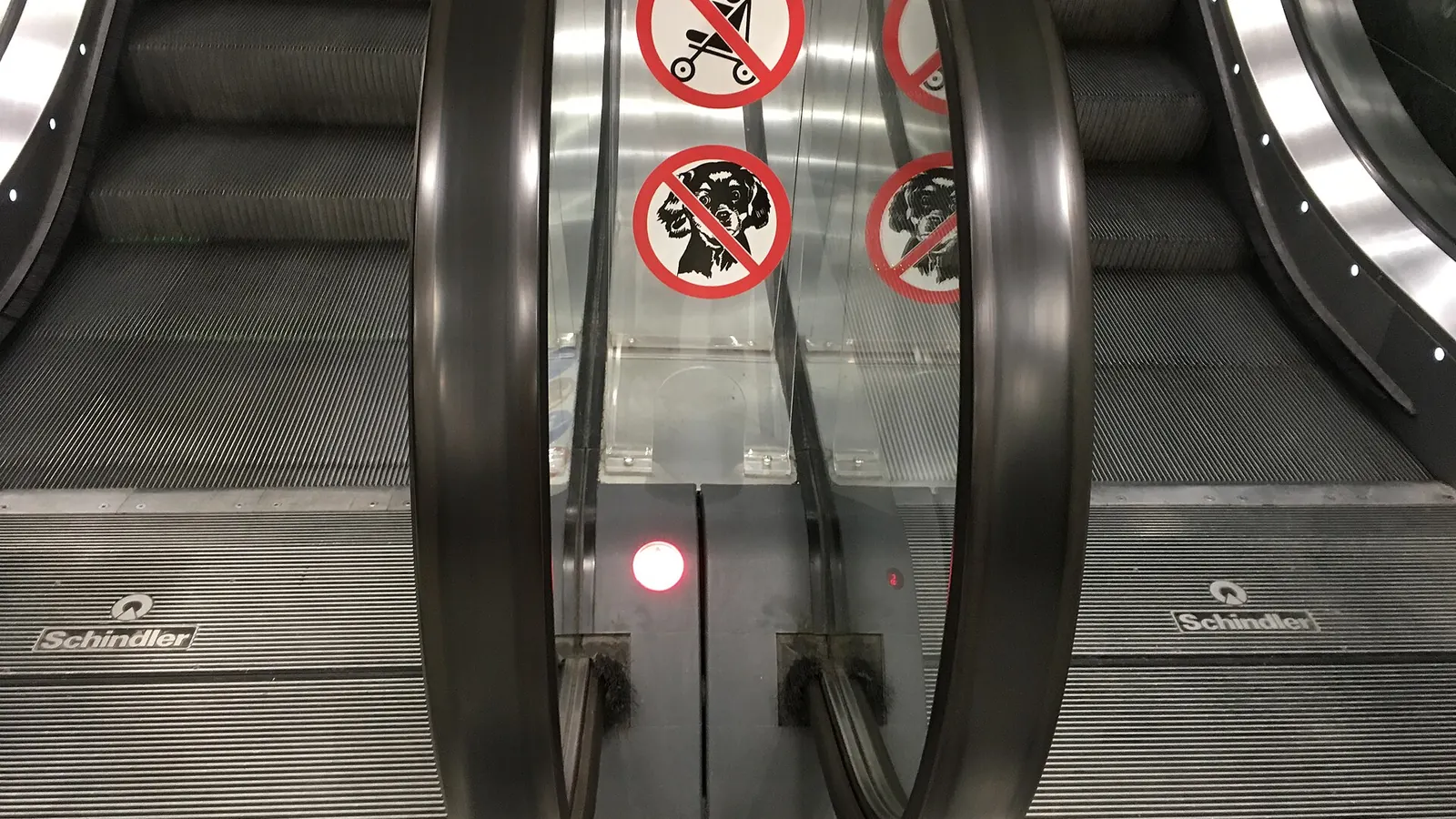
"No dogs or strollers on the escalator (41782127665)" by Eric Fischer is licensed under CC BY 2.0.
The short answer
Can dogs go on Escalators in Australia? Therapy dogs, and dogs generally, are seen more and more in Shopping Centres and other retail spaces, but they should not ride Escalators or Moving Walks on their own paws. Small dogs can be carried and larger dogs should use the Lift. Trained Guide dogs are the exception, because they are trained to enter and exit Escalators safely.
More Shopping Centres, stations and public buildings in Australia are now welcoming dogs, which brings a risk most people haven't thought about: Escalators and Moving Walks.
A dog's paws and the comb-plates at the top and bottom of an Escalator should never meet. This guide explains why, what the Australian Standard requires, and what dog owners and building managers should do.
Why Escalators are dangerous for dogs
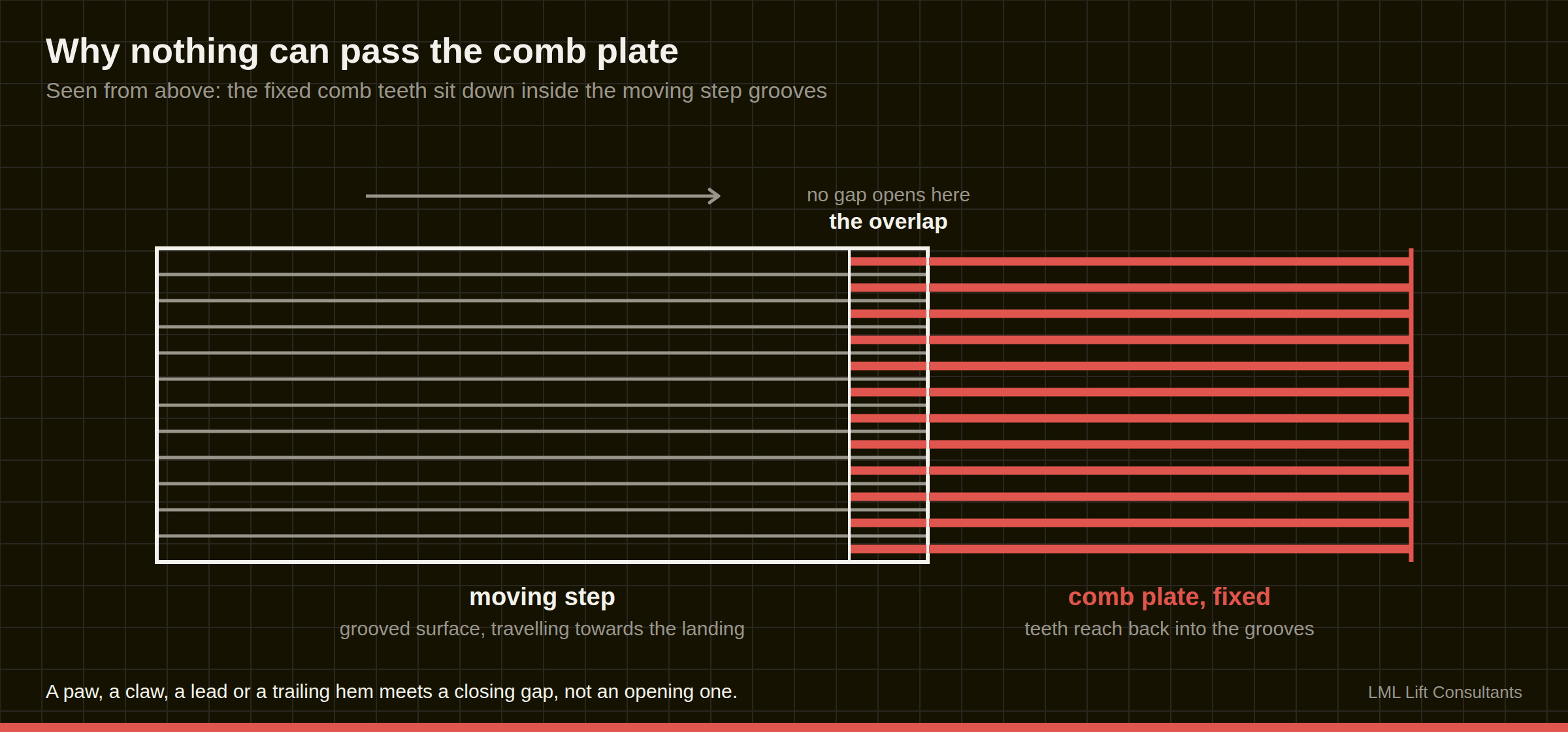
At the top and bottom of every Escalator and Moving Walk are comb-plates. These are 'teeth' meshed with the grooves in the steps and pallets to stop anything being drawn into the gap. Dogs' paws, claws and fur can be caught in the comb-plates or in the gap between a step and the side panel, causing serious injury.
Stopping the Escalator won't necessarily prevent that injury, because for passenger safety an Escalator is designed not to stop instantly even when an emergency stop button is pressed. Under the Australian Standard, an Escalator travelling at 0.5 metres per second may travel between 200 mm and 1,000 mm after a safety device trips. See Escalator and moving walk safety.
What the Australian Standard requires
The Australian Standard for Escalators and Moving Walks (AS 1735.5) requires a warning sign about dogs on every Escalator and Moving Walk, at least 80 mm in diameter. The requirement sits in Clause 7.2, "Signals and warning devices", and Annex G, "Safety signs for the user of Escalators and Moving Walks".
80 mm
the minimum diameter of the required dog warning sign
An 80 mm sign is easy to miss, and it is only the minimum. We recommend a larger, more prominent dog warning decal, around 300 mm by 450 mm, fitted at the top and bottom on one side of each unit, opposite the standard safety decals. One retail Client has asked for that size.
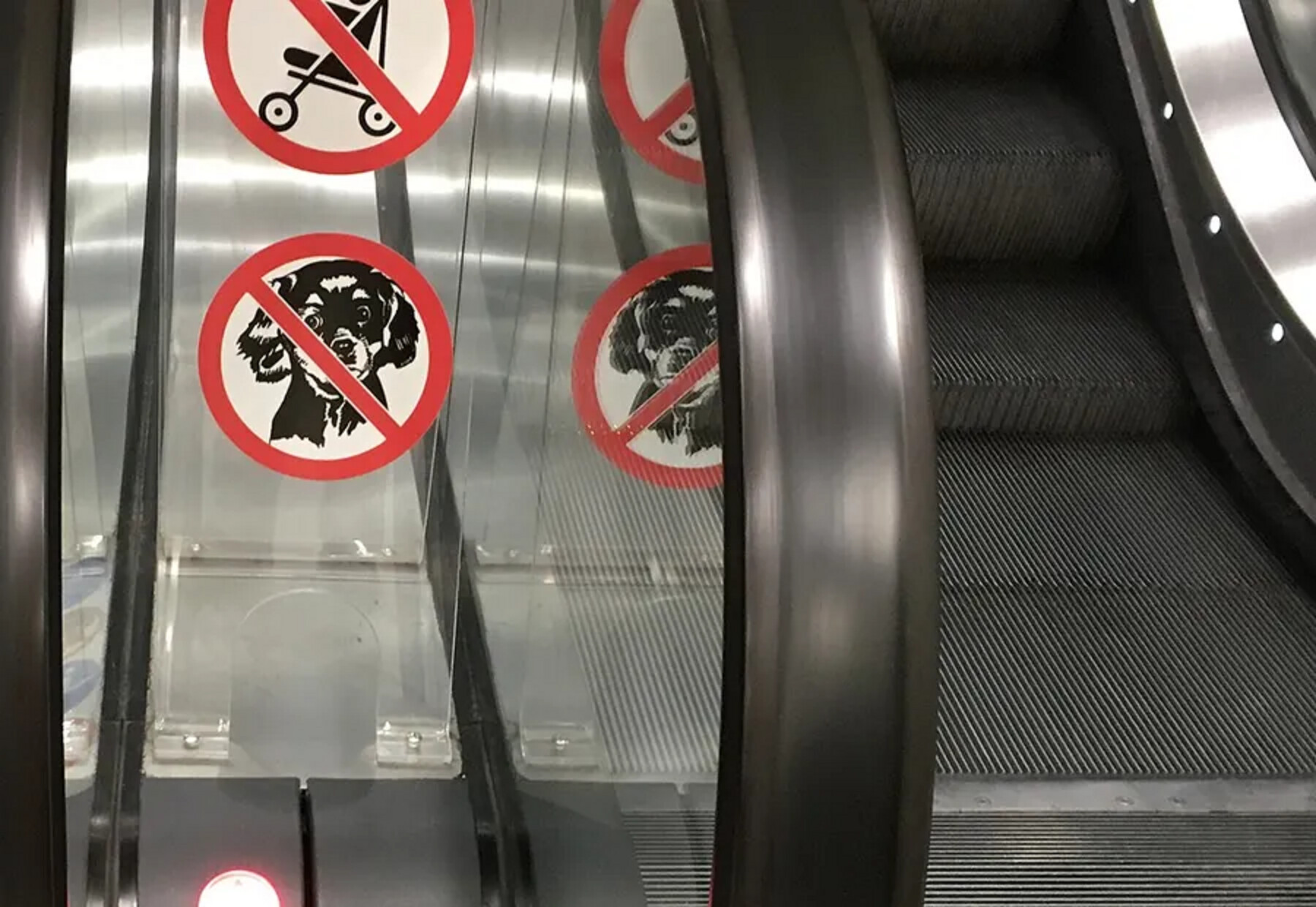
Example of a dog warning decal fitted to an Escalator balustrade, beside the pram decal.
Advice for dog owners
Carry small dogs, if you can hold them comfortably with one hand free for the handrail.
Pick your dog up well before entry to the Escalator, and put them down well after, so they can't step on.
Use the Lift for larger dogs, keeping the lead well clear of the doors.
On a Moving Walk, in some cases a larger dog rides in the trolley where it is acceptable.
Never let a dog walk onto an Escalator or Moving Walk, even for a moment.
Seen from above: the comb teeth sit down inside the step grooves, so nothing fits through.
Advice for Centre and Building Managers
Fit clear, prominent signage at the approach to every Escalator and Moving Walk, in addition to the minimum-size sign.
Direct dog owners to the Lifts with wayfinding signs.
Brief staff on the policy and on what to do if they see a dog on an Escalator.
Include signage in your audits: check the required signs are present and legible on every unit.
Questions people ask
Can dogs go on Escalators in Australia?
Therapy dogs, and dogs generally, are seen more and more in Shopping Centres and other retail spaces, but they should not ride Escalators or Moving Walks on their own paws. Small dogs can be carried and larger dogs should use the Lift. Trained Guide dogs are the exception, because they are trained to enter and exit Escalators safely.
What sign is required for dogs on Escalators?
The Australian Standard requires a dog warning sign at least 80 mm in diameter on each Escalator and Moving Walk, under Clause 7.2 and Annex G of AS 1735.5.
Why can't dogs walk on Escalators?
Their paws, claws and fur can be caught in the comb-plates or the gaps at the sides of the steps.
Safety decals and audits
LML supplies Escalator safety decals, including the larger dog warning decal, in Australian-made, UV-resistant vinyl, and can customise them for your building. We also audit Escalators and Moving Walks, including the signage installed.
{"@context":"https://schema.org","@graph":[{"@type":"Article","@id":"https://www.lmlliftconsultants.com.au/insights/dogs-on-escalators#article","headline":"Dogs on Escalators: what the Standard requires and what owners should do","description":"Why Escalators are dangerous for dogs, the warning sign the Australian Standard requires, and what dog owners and Centre Managers should do.","image":"https://cdn.prod.website-files.com/6a7fae302f0dc30b599e95e0/6ab4f20e48cfbcb4eb7e3c5b_dogs-on-escalators.webp","datePublished":"2026-09-29T07:02:48.000Z","dateModified":"2026-09-29T07:02:48.000Z","author":{"@id":"https://www.lmlliftconsultants.com.au/#organisation"},"publisher":{"@id":"https://www.lmlliftconsultants.com.au/#organisation"},"mainEntityOfPage":{"@id":"https://www.lmlliftconsultants.com.au/insights/dogs-on-escalators#webpage"},"inLanguage":"en-AU"},{"@type":"WebPage","@id":"https://www.lmlliftconsultants.com.au/insights/dogs-on-escalators#webpage","url":"https://www.lmlliftconsultants.com.au/insights/dogs-on-escalators","name":"Can Dogs Go on Escalators? What the Standard Requires","isPartOf":{"@id":"https://www.lmlliftconsultants.com.au/#website"},"breadcrumb":{"@id":"https://www.lmlliftconsultants.com.au/insights/dogs-on-escalators#breadcrumb"},"primaryImageOfPage":"https://cdn.prod.website-files.com/6a7fae302f0dc30b599e95e0/6ab4f20e48cfbcb4eb7e3c5b_dogs-on-escalators.webp","inLanguage":"en-AU"},{"@type":"BreadcrumbList","@id":"https://www.lmlliftconsultants.com.au/insights/dogs-on-escalators#breadcrumb","itemListElement":[{"@type":"ListItem","position":1,"name":"Home","item":"https://www.lmlliftconsultants.com.au/"},{"@type":"ListItem","position":2,"name":"Insights","item":"https://www.lmlliftconsultants.com.au/insights"},{"@type":"ListItem","position":3,"name":"Dogs on Escalators: what the Standard requires and what owners should do"}]}]}
Get an independent view before you decide
We sell no equipment and take no commissions. Tell us about your building and a consultant will come back to you.