Contracts
Before you renew your Lift maintenance contract: what to check
What to check in your current Lift maintenance contract before you renew it: the roll-over clause, obsolescence, inclusions, exclusions and service levels.
What to check in your current Lift maintenance contract before you renew it: the roll-over clause, obsolescence, inclusions, exclusions and service levels.
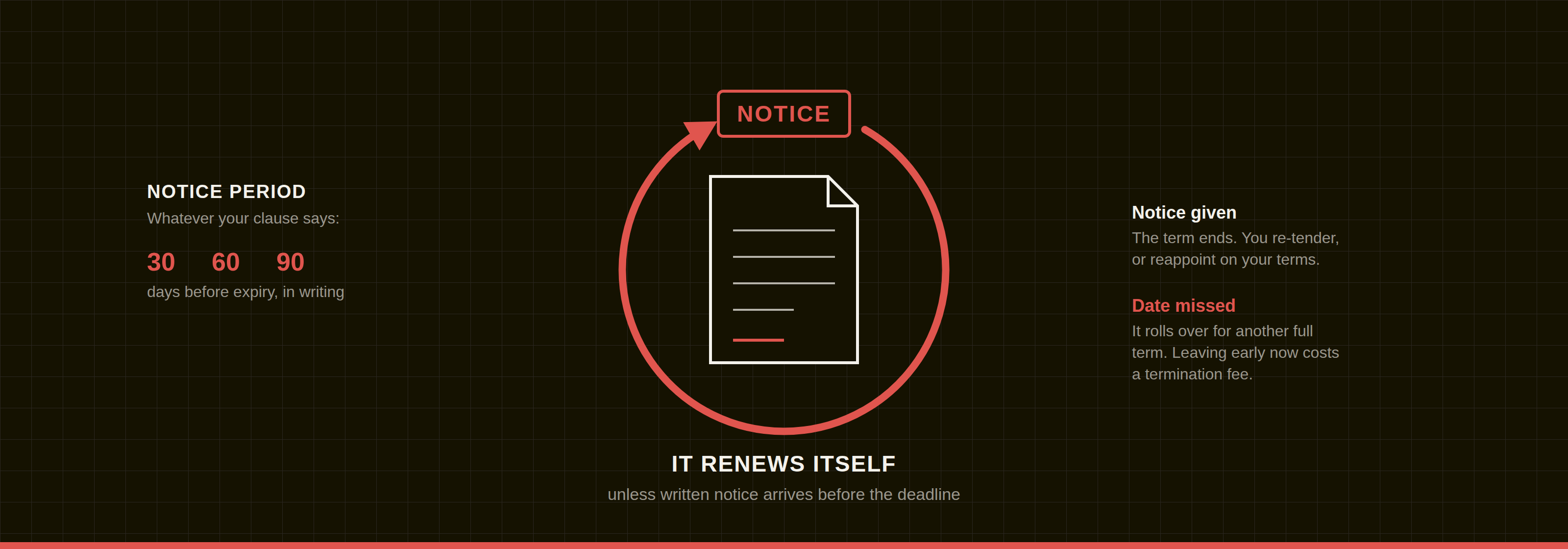
How much notice do I need to give to stop a Lift contract rolling over? Usually 30, 60 or 90 days before expiry, in writing. The exact period is set out in the roll-over or termination clause of your contract.
Want an independent view of your own lifts?
Talk to a consultantThe end of a Lift maintenance contract is the best chance you will get to fix what hasn't been working. The contractor wants to keep the work, and nothing is locked in yet, so this is when the Owner has the most say over the terms.
Most contracts don't get that attention. They roll over automatically, often for another three or five years, because nobody diarised the notice date, or they are renewed on price alone without anyone checking what the price buys.
This guide covers what to check before you renew or re-tender. It draws on more than a decade of reviewing Lift and Escalator contracts for Owners Corporations, Facilities Managers and Asset Managers, and it applies whether you manage one Lift or a portfolio of fifty buildings.
Before you can manage your contracts, you need to see them all in one place. Many managers inherit contracts with several contractors, each on its own terms and with its own expiry date, and nobody has a full picture of what is in place.
Keep a simple register with one row per building and these columns:
The register takes an afternoon to set up, and it prevents the most common and most expensive mistake, which is missing a notice date.
If you would like a hand setting up the register or working out your notice dates, contact us.
Almost every standard lift maintenance contract has a roll-over clause, sometimes called a termination or renewal clause. If you don't give written notice within a set period before expiry, the contract renews automatically, usually for the same term as the original.
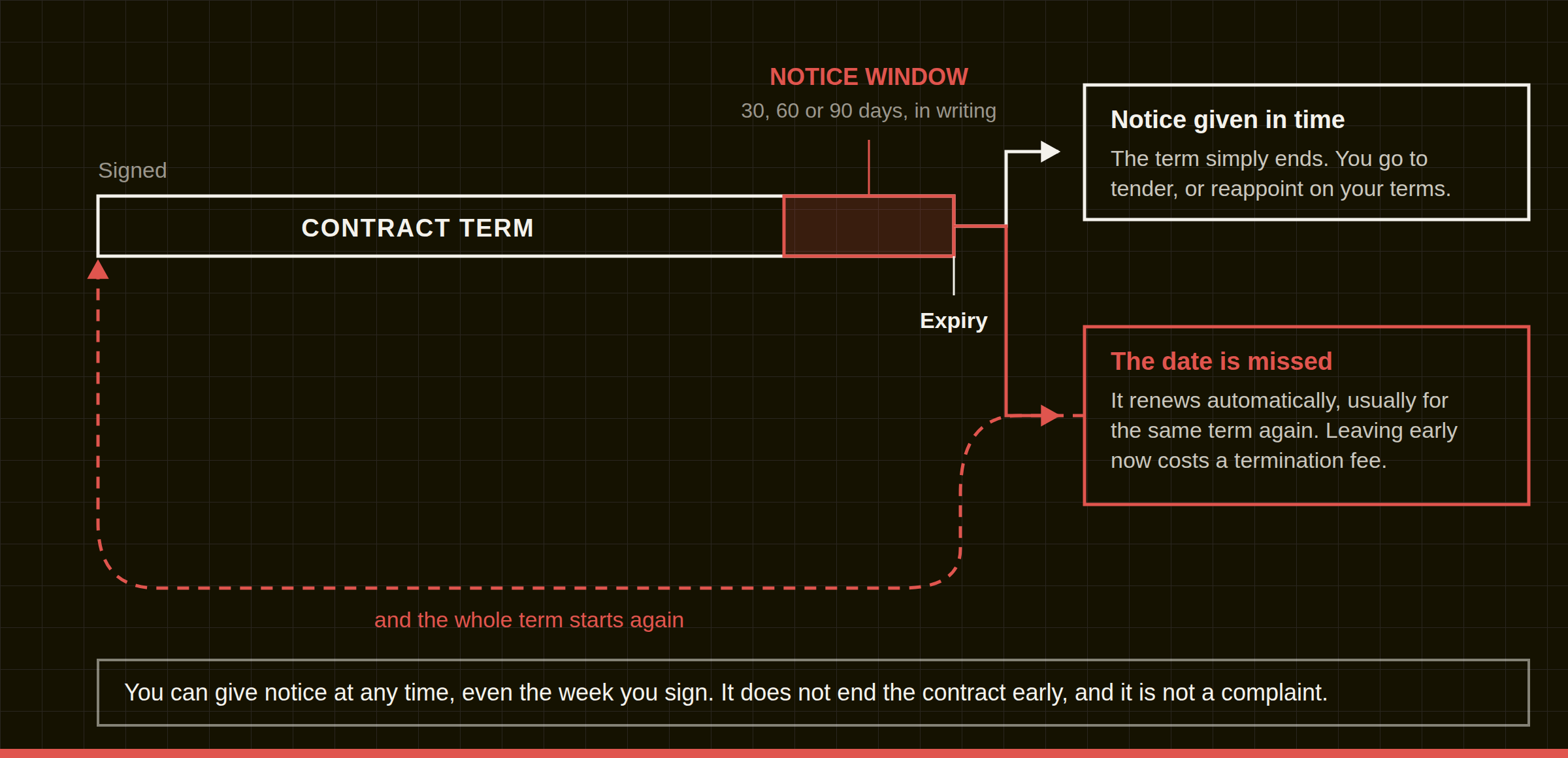
You can give notice to stop roll-over at any time. The contract still runs to the end of its term; the notice only stops it renewing itself. If you send it early and diarise the contractor's acknowledgement, the contract can't roll over because a date was missed.
An automatic renewal is manageable on a one-year contract. On a five- or ten-year contract it is a serious problem, and many buildings still have those older, longer agreements in place. If the contractor is performing poorly, you are locked in. If you want out of a contract that has already rolled over, many contracts charge a termination fee based on the remaining term.
How notice works:
We cover the process step by step, with a sample letter, in How to stop your lift contract rolling over.
The label on the front of the contract tells you less than the clauses inside it, but it is a starting point:
"Fully comprehensive" rarely means everything. The exclusions decide what you end up paying for.
Whichever type you have, check how the price rises each year. Many contracts are tied to a price adjustment formula that runs well above CPI.
Open the contract and search for these words. Each is a common exclusion that can turn a "comprehensive" contract into a string of extra invoices.
An obsolescence clause lets the contractor charge for replacing a component it declares obsolete, meaning parts for it are no longer available. More and more components are being declared obsolete, and what counts as obsolete varies widely between contractors.
Why is everything suddenly obsolete?
Richie Lobert
a VF drive repaired, against the manufacturer's quote to replace it
The most common big-ticket item is the variable frequency (VF) drive, which controls the speed of the Lift motor. Drives fail relatively often and are frequently excluded under obsolescence.
There are often alternatives to replacement:
The simplest protection is to deal with obsolescence before you sign. Ask each tendering contractor to inspect the equipment and list every component it considers obsolete, or likely to become obsolete during the contract term, and agree that list in writing so there is nothing to argue about later.
A contract drafted by the contractor will naturally favour the contractor. Whoever drafts yours, check that it includes:
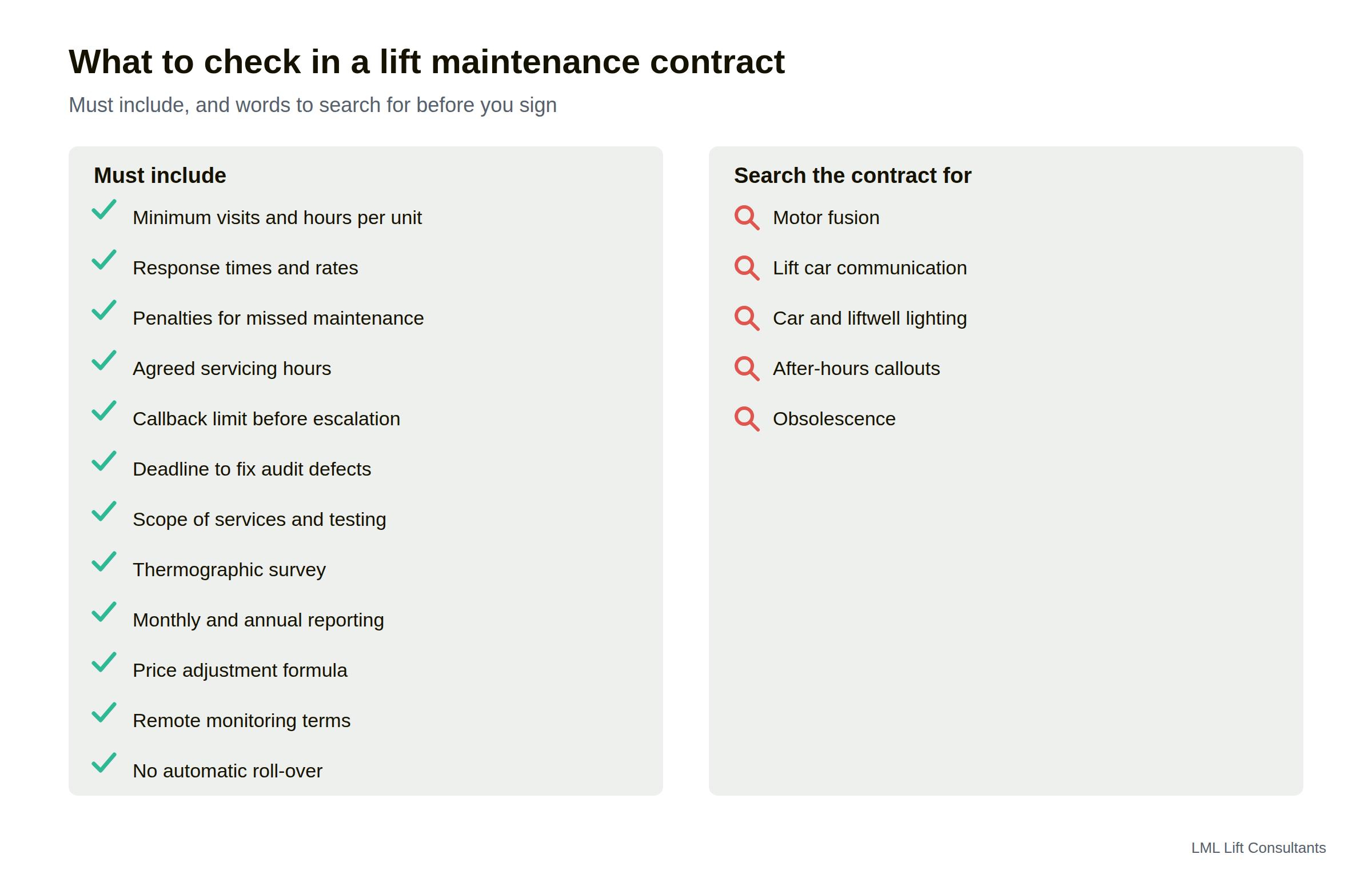
Together these form the basis of a performance-based Maintenance Agreement: one prepared for the Owner, with measurable service levels the contractor must meet. LML prepares these Agreements for Owners and Managing Agents, never for Lift companies. Learn more about maintenance agreements.
A good contract needs someone to check that it is being followed. A few simple habits make that possible:
When you re-tender, a price that looks too good to be true often means "inspection" visits or remote predictive maintenance in place of hands-on work. On an inspection visit a Technician looks at the equipment, ticks a box and leaves, and sometimes an inspection is tacked onto the end of a callout.
If the price appears to be too good to be true, then it likely is.
Richie Lobert
An inspection is only worth paying for if someone acts on what it finds. We regularly see sites where inspection visits continue while obvious problems, such as badly damaged Escalator handrails or visibly rusted hoisting ropes, go unaddressed.
Cheap maintenance that shortens the life of the equipment costs more in the end. Replacing a Lift five years early costs far more than the difference between two maintenance quotes.
Price is one criterion among many. When we recommend a contractor to a Client, we assess:
Score Tenders on safety record, units per Technician, response times and how quickly they close out audit defects, and only then on price.
For an Owners Corporation, the contract renewal usually needs a committee decision and sometimes a vote at the annual general meeting. Work back from the expiry date and allow time for a maintenance audit, the tender, for the committee to consider the recommendation, and for the notice period. Starting six months before expiry is sensible, and earlier still if a maintenance and condition audit is planned first, so that any defects it finds can be dealt with before the contract expires. See lift services for owners corporations.
LML writes its performance-based maintenance agreements for the Owner and Tenders them to approved Maintenance Providers. Each one sets:
Usually 30, 60 or 90 days before expiry, in writing. The exact period is set out in the roll-over or termination clause of your contract.
No. Most comprehensive contracts exclude items such as motor fusion, car communication, lighting and obsolete components. Many also set a financial amount for repairs covered such as to a maximum of $5,000 per repair. Check the exclusions list.
Sometimes, but many contracts charge a termination fee based on the remaining term. Giving notice to stop roll-over well before expiry avoids the problem.
Ideally someone acting for the Owner. A contractor's standard agreement is written to protect the contractor, while an independently prepared, performance-based agreement protects the Owner and the equipment.
A Lift maintenance contract runs for years and can cost tens of thousands of dollars a year. Left alone, it renews itself and the decision gets made for you.
LML Lift Consultants reviews existing contracts, prepares performance-based maintenance agreements and runs re-tenders for Owners, Owners Corporations and Managing Agents across Australia, New Zealand and Papua New Guinea. We work on every major brand of Lift and alongside every Lift company in the market, but we sell no equipment and take no commissions.
Call 1300 001 565 or send us your contract for a review.
We sell no equipment and take no commissions. Tell us about your building and a consultant will come back to you.