Planning and compliance
Planning Lift capital costs over ten years
How to build a ten-year capital plan for your Lifts and Escalators, so you can budget for replacements and upgrades well before the equipment fails.
How to build a ten-year capital plan for your Lifts and Escalators, so you can budget for replacements and upgrades well before the equipment fails.
How far ahead should a Lift capital plan look? Ten years is probably standard, reviewed every year, and some Owners plan further ahead for major modernisations. If you run a periodic equipment audit, the plan can be examined carefully and the timing of each item identified.
Want an independent view of your own lifts?
Talk to a consultantLifts are among the most expensive assets in a building to replace. Yet in many buildings the first anyone hears of a modernisation is when the contractor says a part is obsolete, or the Lift fails for good.
A capital plan sets out, years ahead, when each Lift and Escalator will need work, what that work will involve and roughly what it will cost. Replacements then become budgeted projects, planned around the building.
This article explains what a Lift capital plan contains and how to build one.
the standard horizon for a lift capital plan, reviewed every year
A list of every Lift and Escalator, with its brand, model, year of installation, controller type, number of floors served, and any previous modernisation.
This should come from an independent audit, not the contractor's opinion. It records the condition of each major component: machine, controller, drive, doors, ropes, car interior, fixtures and safety equipment.
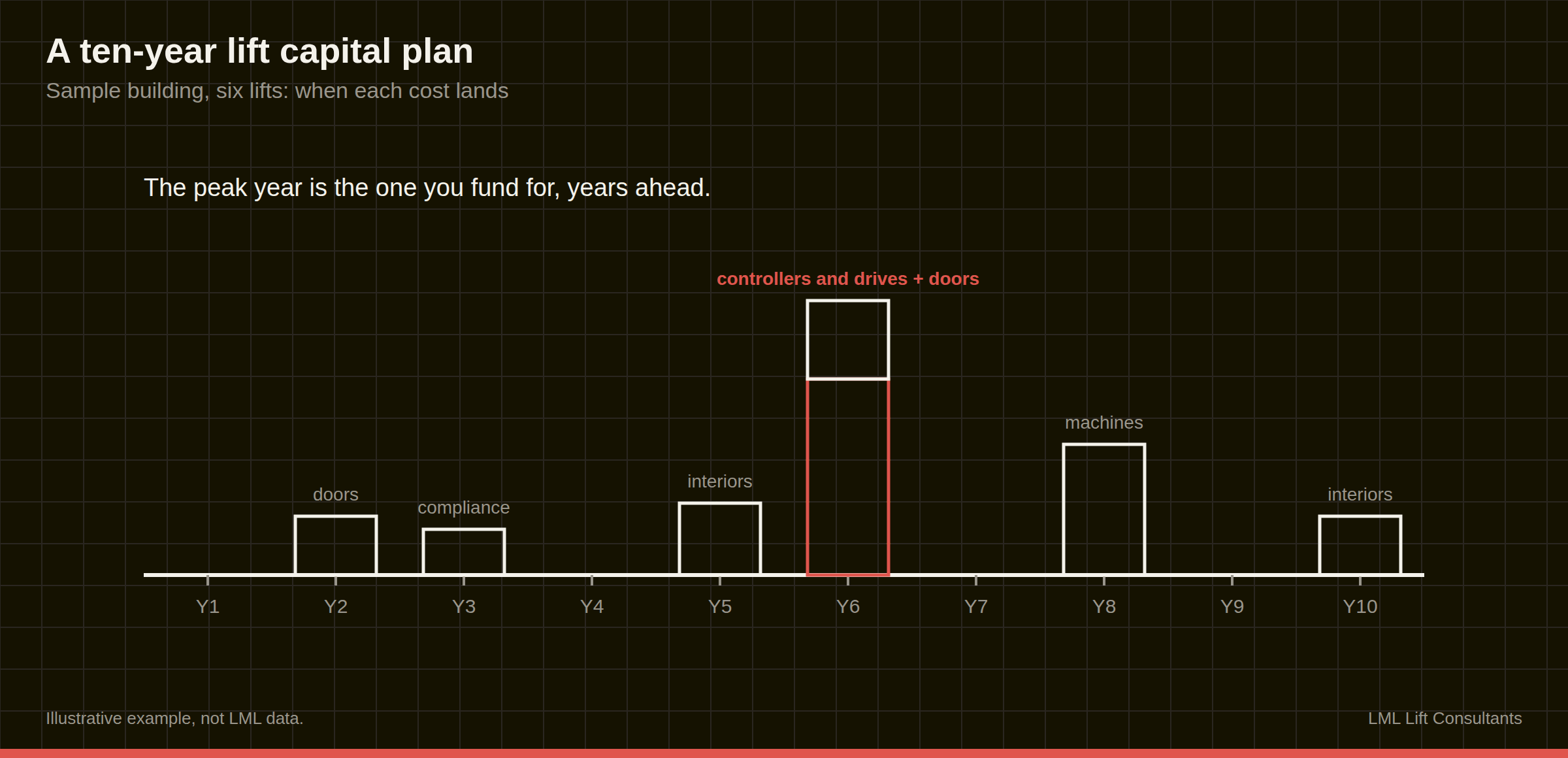
Components wear out at different rates, so a lift doesn't usually need everything replaced at once. Controllers and drives often need replacing after 15 to 20 years, as parts become hard to source, while machines, rails and structural items can last much longer.
The plan should show which components are, or will soon be, unsupported by their manufacturer. Obsolescence can bring forward a replacement by years, and it varies between manufacturers and contractors. See Before you renew your lift maintenance contract.
This covers work needed to meet current standards, safety requirements or accessibility expectations, even where the equipment still works.
Each item gets a likely year, a cost range and the options. A range is more useful than a single figure, because building works that can't be seen until the job starts can change the price.
A capital plan is only useful if it stays current.
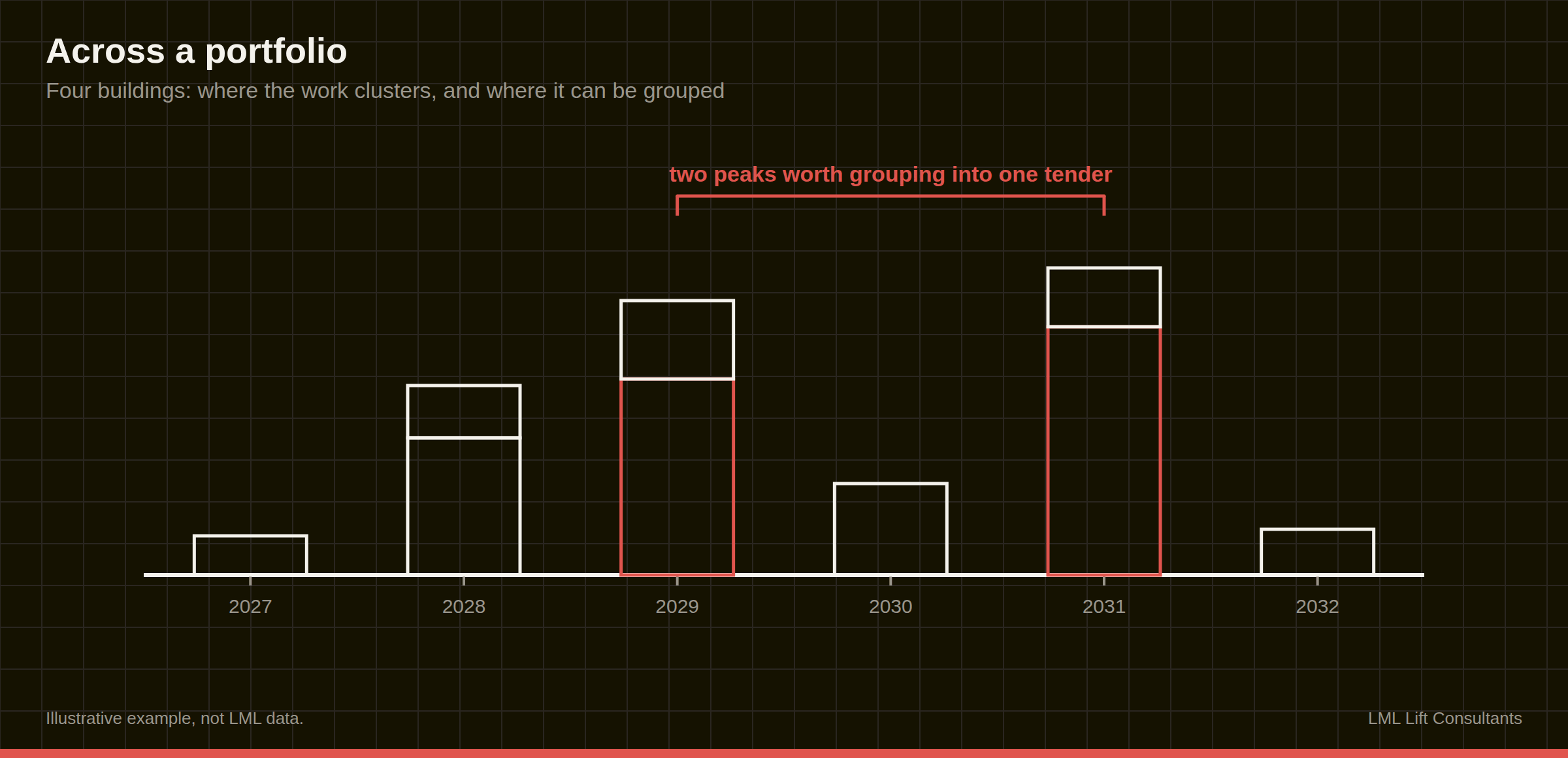
Across several buildings, the plan becomes a portfolio view: which sites need work first, how costs spread across years, and where projects can be grouped to get better prices. LML brings the audit results, equipment data and forecasts for every building together to do this.
The plan's years and dollar figures depend on the assessment behind them. LML's lifecycle and feasibility assessment gives each lift a remaining-life estimate, a high-level scope of works, a budget price and an indicative programme. Those four outputs feed straight into the plan, and they are refreshed after each annual audit.
Ten years is probably standard, reviewed every year. Some owners plan further ahead for major modernisations.
Someone independent of the maintenance contractor, who can assess the equipment's condition and the real options without selling the replacement.
It depends heavily on the building and the equipment. A condition assessment and capital plan give a realistic range for your lifts.
LML Lift Consultants prepares capital plans for single buildings and whole portfolios, based on independent audits and experience from more than 230 modernisation projects. We sell no equipment and take no commissions.
Talk to us about a capital plan or call 1300 001 565.
We sell no equipment and take no commissions. Tell us about your building and a consultant will come back to you.